
DNS Footprint
Complete DNS visibility: domains, every resolving subdomain, the full record inventory, and change tracking between assessments.

Namespace Command is the enterprise platform for Digital Governance Intelligence. It continuously discovers, monitors, analyses and governs your entire internet-facing estate from the outside, with nothing to install and no access to your environment.
It closes the four gaps every estate carries: assets nobody knew existed, findings nobody owns, evidence nobody is continuously collecting, and incidents that should have been prevented.
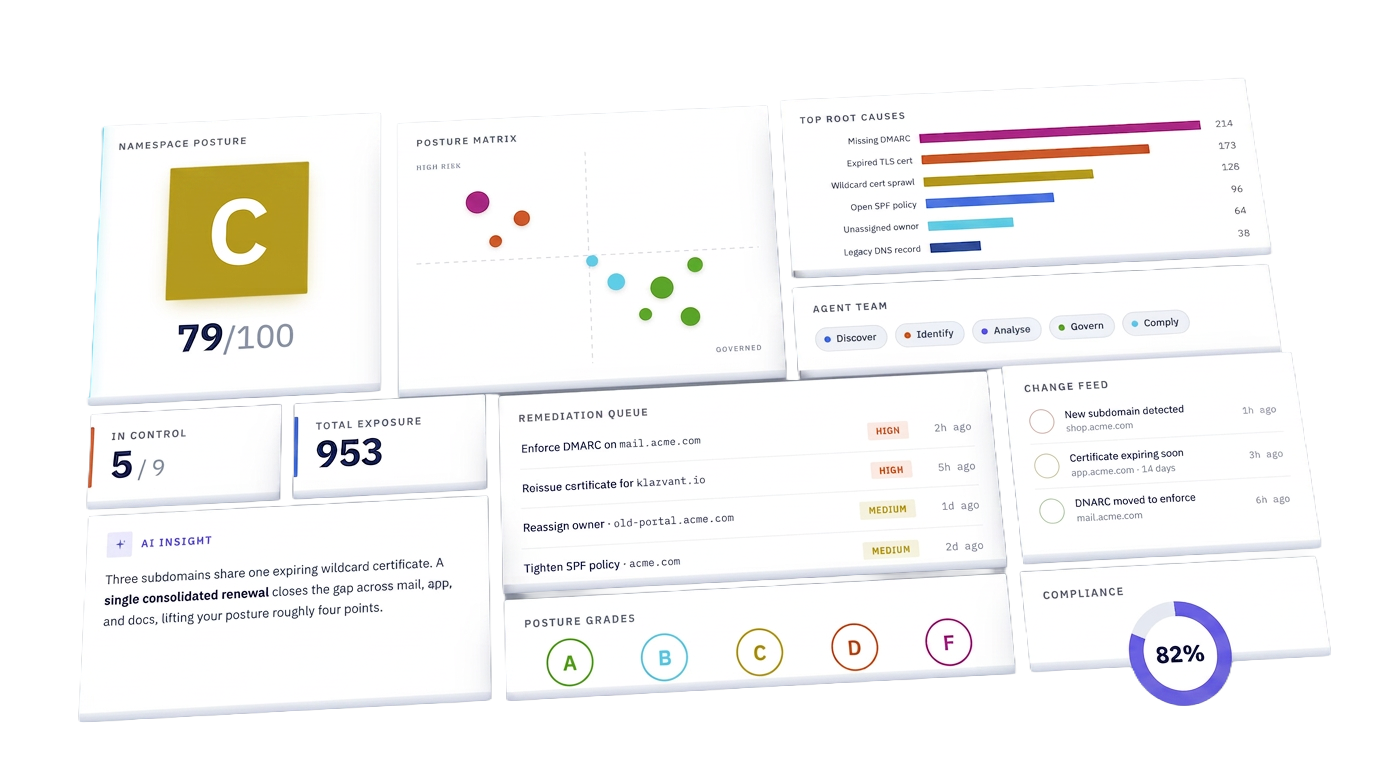
Illustrative render of the Klarvant Namespace Command experience. Klarvant does not publish screenshots of the live platform; this visualisation conveys the structure of the interface without exposing customer data or production UI.
At a glance
One screen compresses the whole assessment: an A to F posture grade rolled up from every domain and subdomain, the root causes driving your findings, the ranked remediation queue, and the compliance evidence behind it. The headline reads in a glance; the detail is one click away.
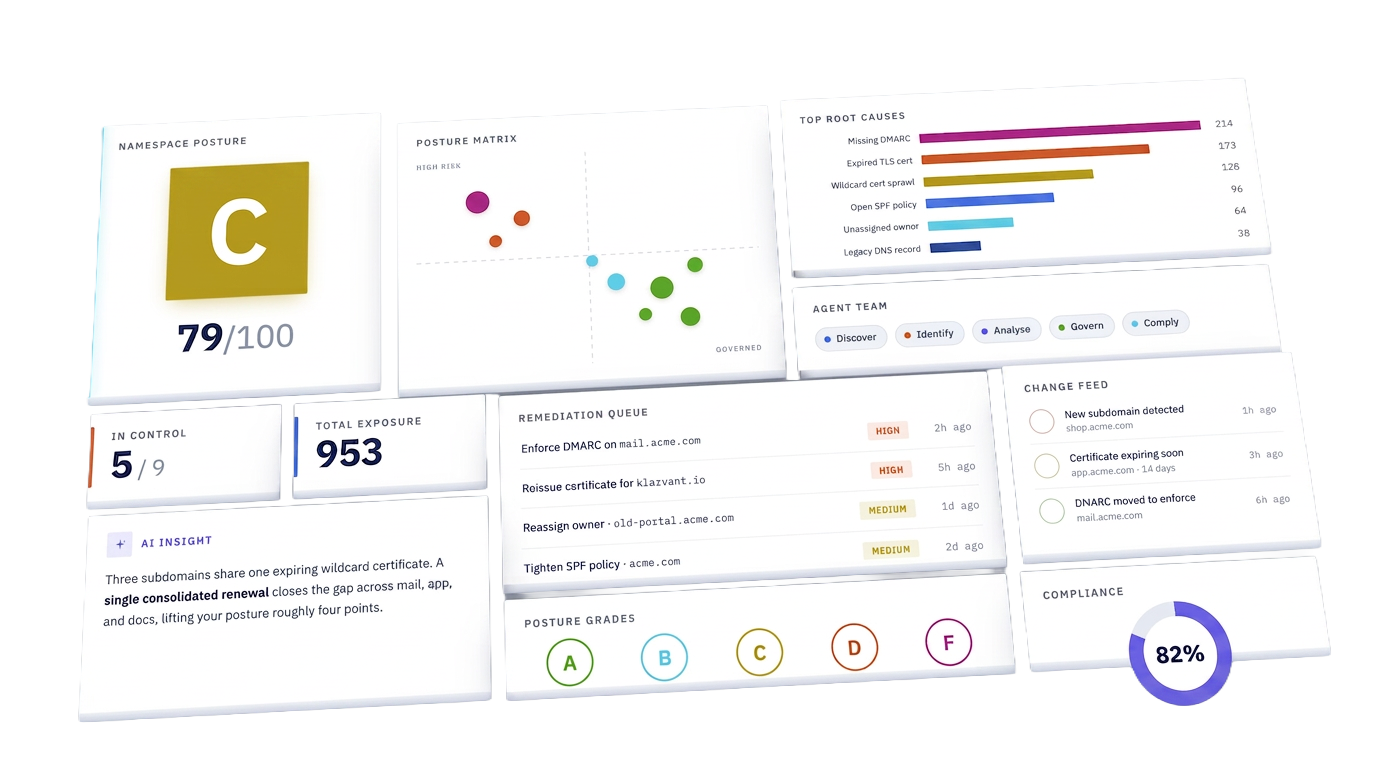
Illustrative render of the Klarvant Namespace Command experience. Klarvant does not publish screenshots of the live platform; this visualisation conveys the structure of the interface without exposing customer data or production UI.
By role
Five seats, one digital estate. Pick yours.
CISO / Head of Security
Klarvant turns the discoverable external estate into a governed asset list with owners, an A to F posture rating across seven categories, and clear remediation paths. Risk concentration is explained by root cause, not just ranked by severity, so you can show the board where the systemic gaps are and where the next pound of investment belongs. Findings that matter, finished, and a posture trend you can defend quarter on quarter.
See it in a demoGRC / Compliance
Controls are evaluated automatically against your real asset data, not a questionnaire, and scored pass, fail, or warning. The compliance engine is framework-agnostic, so the same control can satisfy requirements across any framework you assign, including your own internal policy; NIST CSF, ISO 27001, SOC 2, CIS Controls, HIPAA and GDPR are recognised examples. Thirty-day drift analysis surfaces regression before the auditor does.
See it in a demoSecOps / IT Operations
Discovery starts at onboarding with zero integration, so the inventory is complete before anyone has filed a ticket. Every finding arrives with severity, root cause and the asset it belongs to, mapped to a verified owner at zone, domain, vendor or service level, so it routes to the right team without triage. Verify Fix confirms a remediation actually landed in minutes rather than at the next scan, and Impact Search answers "where are we affected?" the moment a vendor incident breaks. Less time establishing what is yours, more time fixing what is broken.
See it in a demoBrand / Legal Counsel
The brand surface is part of the asset graph, not a separate tool with a separate login. Lookalike domains, impersonation and content drift are discovered on the same nine surfaces as everything else you own, and they arrive with the same verified ownership at zone, domain, vendor and service level. That means a trademark issue and a certificate issue reach the accountable person by the same route, with the same evidence trail behind them. When counsel needs to demonstrate that a mark has been monitored and defended, the record already exists rather than being reconstructed. External Discovery covers shadow assets, impersonation and phishing, with a claim-and-approve workflow and professional takedown support.
See it in a demoM&A / Corporate Development
Klarvant maps a target's external footprint without engaging them, including third-party dependencies and supplier chains. Better-informed transactions, fewer post-close surprises, a defensible record of what was assessed at signing.
See it in a demoDiscover
Discovery is fully external and needs nothing installed. Every surface is monitored continuously, with historical comparison between assessments, so you see exactly what changed.
Complete DNS visibility: domains, every resolving subdomain, the full record inventory, and change tracking between assessments.
The whole certificate estate, every TLS endpoint, expiry forecasting, and post-quantum readiness, including certificates issued but not yet deployed.
Sender-authentication posture across SPF, DMARC, and DKIM, plus mail-server transport security per host.
Complete IP inventory with geolocation, network-operator distribution, and an interactive endpoint map.
Page inventory with security-header analysis, look-alike grouping, third-party script checks, and technology detection.
Brand-threat intelligence: shadow assets, impersonation and phishing, a claim-and-approve workflow, and professional takedown support.
Supplier inventory and dependency graph with concentration analysis and change-impact monitoring.
Data-residency mapping: jurisdiction, endpoint geography, cloud-region usage, and cross-border data flows.
Detected-technology inventory with version tracking for vulnerability assessment and change monitoring over time.
The connected model
Discovery gives you everything you own. The Ontology turns it into one living model of your external ecosystem: 26 object types, 20 relationship types, and provenance on every single element, so you can always see whether a fact was observed, enriched, derived or asserted. It arrives populated from day 1 by the platform's own observation. There is no modelling engagement, no schema workshop, and nothing to fill in.
Ring 1
Observed
14 object types
Ring 2
Enriched
6
Ring 3
Derived
3
Ring 4
Asserted
3
Digital twin
The digital twin shows interconnected assets, dependency chains, and blast radius, making invisible risk visible.
Interactive visualisation
Drag to rotate · Scroll to zoom
13
Organisation domains
.com, .uk, .de, .jp, .cn, .au, .sg, .za, .eg, .co, .br, .in, .ca
14
Supplier dependencies
AWS, Azure, GCP, Cloudflare, Akamai, Oracle, and more
3
Suppliers in simulated outage
AWS US-East, Azure, OVH affected
Illustrative visualisation with example data.
Explore the digital twin simulationHow risk is scored
Every domain, organisational unit, and organisation gets a letter grade, rolled up from seven categories so a parent domain reflects everything beneath it.
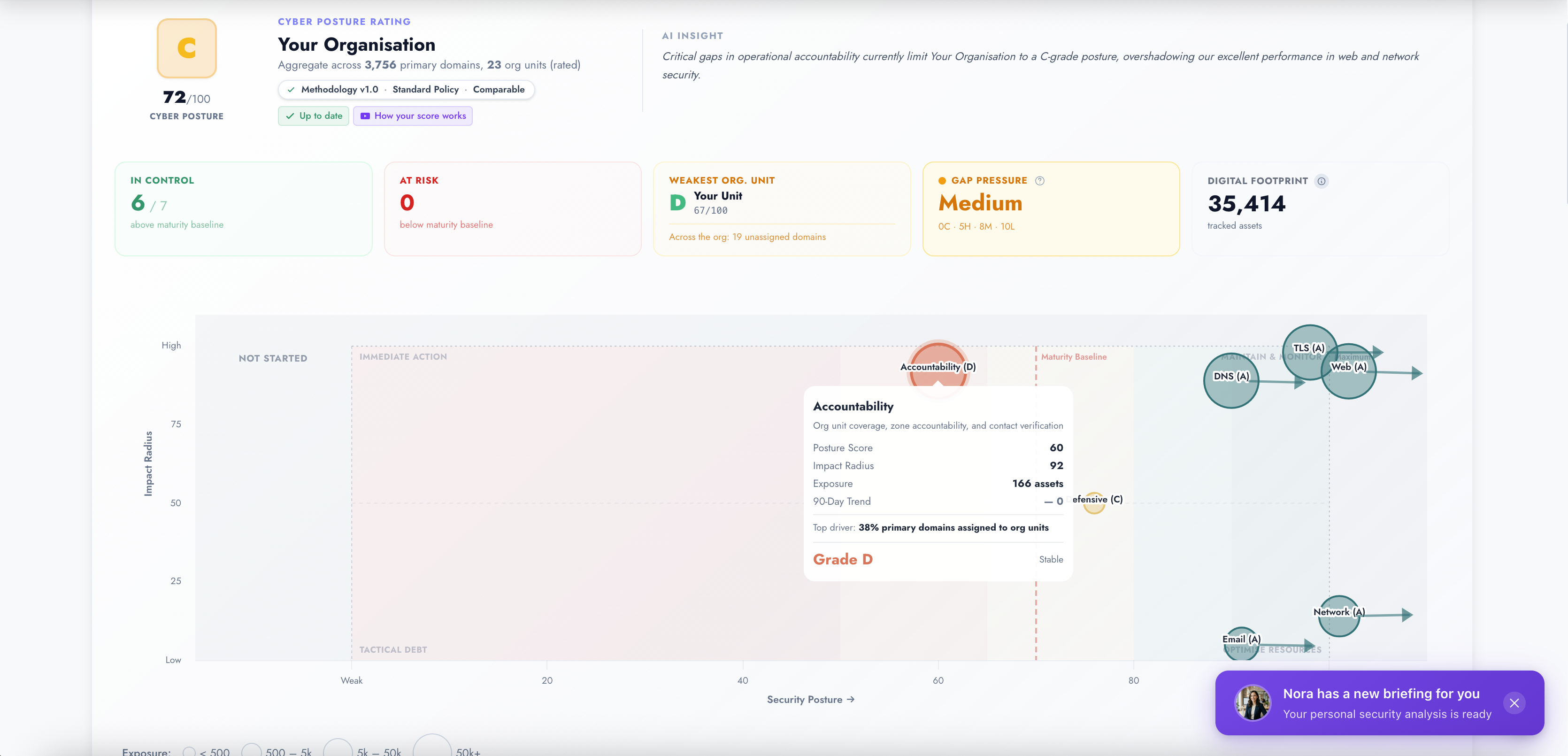
The posture rating in Klarvant Namespace Command.
DNS, TLS, Email, Web, Network, Accountability, and Defensive. Each yields a 0 to 100 score that rolls up into an A to F grade.
Open findings reduce the relevant scores in proportion to severity, and a serious condition, such as an expired certificate, caps the final grade.
Findings map to seven strategic root causes, so the platform reports not just what is wrong but why a whole category keeps recurring.
Meet Nora
Thirteen specialist AI analysis areas interpret what the platform observes. Nora, your personal advisor, turns that into something you can act on and repeat to a board without translation. Below, Nora walks through how the posture score is built and what moves it.
Watch Nora explain the posture score (1 min 28)
See it in action
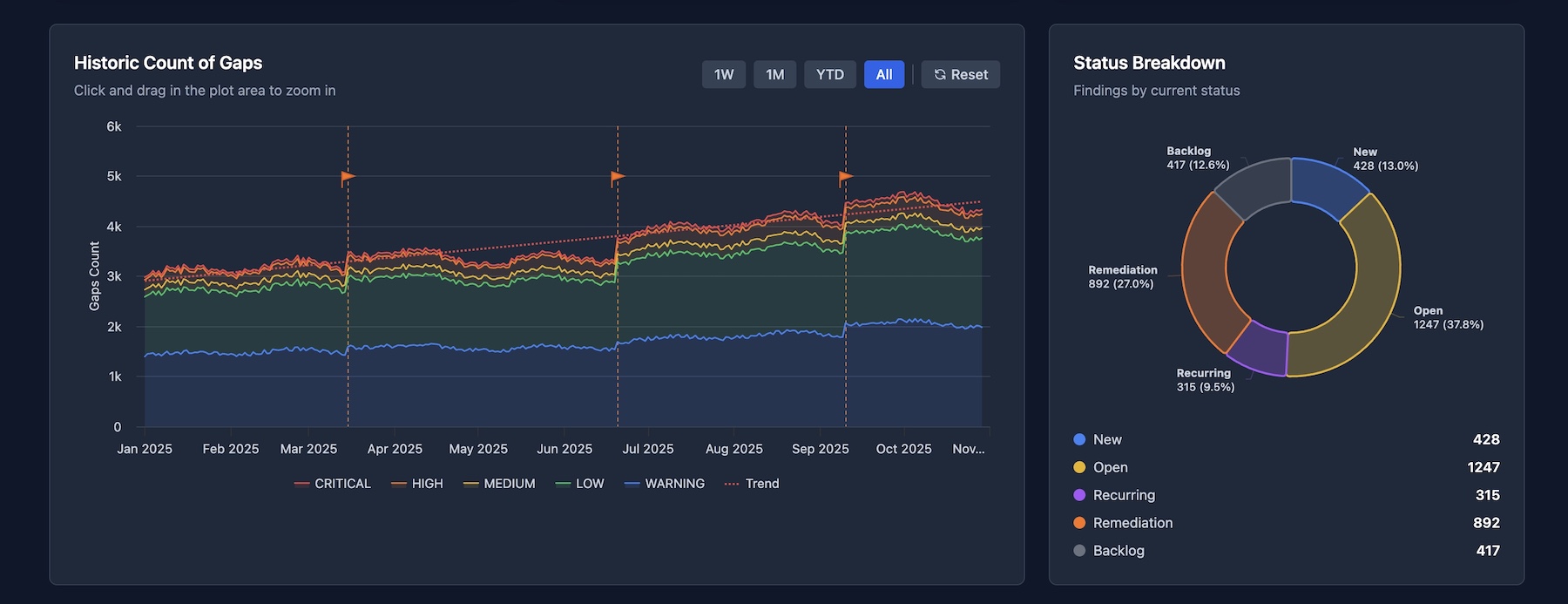
How findings trend over time, and how the platform turns them into a posture score and a prioritised queue.
A CVE on its own is a number. Dependency Signals attaches exploitation context to it, including KEV and EPSS, so the question is not "does this CVE exist in our estate" but "is anyone actually exploiting it, and does it reach anything of ours".
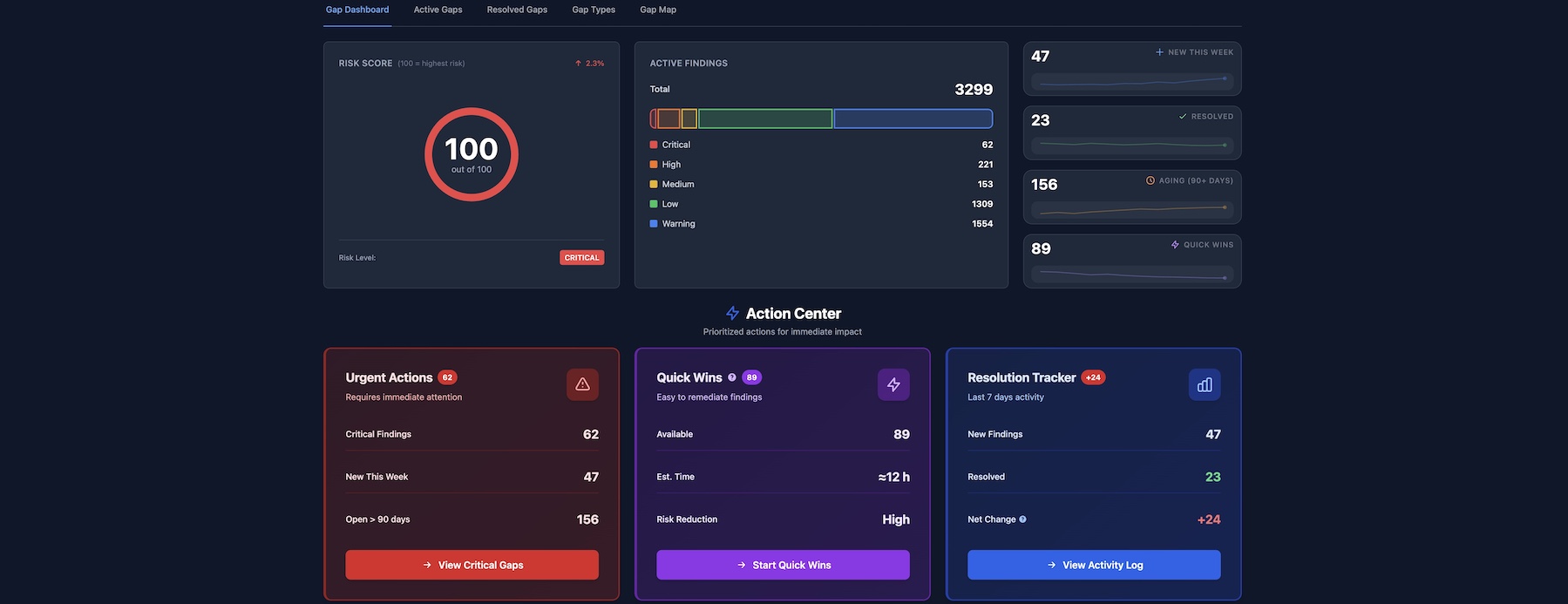
Agent for Gemini Enterprise
The Klarvant Digital Governance Analyst tracks post-quantum migration, monitors supply-chain risk and surfaces external exposure across your namespace, with audit-ready compliance evidence attached to every answer.


No-code automation
Apps carry out your standing instructions. Drag and drop eight building-block types into a chain, choose from six trigger types, and the App runs after every completed assessment: watch, analyse, notify, act. AI can draft one from a plain-language description, and you review it before it runs. Actions land in the intelligence feed, in-app, email, Slack or Jira, and every one is recorded in the App actions ledger. Twelve ready-made templates to start from.
Describe the App. Review it. Run it.
Scale
7B+
Identifiers mapped across the corpus
200+
Defined finding types, each with remediation guidance
120+
Security metrics captured per assessment
249
Countries supported across data-residency regions US, EU, UK
Reference figures from the live Namespace Command V4 platform.
Continuous compliance
The compliance engine is framework-agnostic: it can represent any framework, including your own internal policy. Map the estate to the frameworks you answer to, and the platform keeps the evidence current between audits, not only at audit time. The chips below are recognised examples, not a ceiling.
Controls are checked automatically against your actual asset data and scored pass, fail, or warning. No questionnaires, no self-attestation.
The same control can satisfy requirements across several frameworks at once, so evidence is collected once and reused, not rebuilt for every audit.
Every failure pinpoints the specific assets responsible, and 30-day drift analysis surfaces a slipping posture before an auditor would.
Consumption
The same governed dataset, reachable five ways: the web platform, CSV and JSON export, the REST API, MCP for AI assistants, and A2A for agent-to-agent automation.
The five-pillar lifecycle
Complete visibility. Governed action. Compliance without limits. Namespace Command runs the same five-stage lifecycle across your entire external estate, governed under one model, with a pre-built Ontology and no-code Apps layered on top. See how each stage works in depth.
See everything
Zero-integration discovery across nine discovery surfaces, including domains, certificates, email, suppliers, and brand exposure. Results from day 1.
Find the gaps
Findings are detected and classified automatically after each assessment, then tracked through a full lifecycle with a complete audit trail.
Understand risk
Thirteen specialist AI areas and the personal advisor, Nora, turn findings into plain-language briefings and root-cause insight, over the pre-built Ontology of your external digital ecosystem.
Create accountability
Assign verified owners to every zone, set standards and thresholds, and drive remediation. No-code Apps can act on findings, opening a Jira ticket, posting to Slack, or notifying the accountable owner, so nothing sits unowned.
Prove it
The compliance engine is framework-agnostic. Controls are evaluated continuously against real asset data, and can represent any framework, including your own internal policy, with audit-ready evidence.
FAQ
Nothing to install: no agents, no API keys, no privileged access. Discovery works entirely from publicly observable data, such as DNS, certificate transparency, WHOIS, and web content, so there is no integration overhead and no access into your environment.
Discovery begins immediately at onboarding, with results from day 1. Time to a first complete snapshot scales with the size of your namespace, not the complexity of setup: no configuration, no vendor participation, no setup delay.
Nine discovery surfaces: DNS, certificates, email security, IP intelligence, web surface, external discovery (brand), third-party suppliers, digital sovereignty, and technologies.
The compliance engine is framework-agnostic: it can represent any framework, including your own internal policy. NIST CSF, ISO 27001, SOC 2, CIS Controls, HIPAA and GDPR are recognised examples, not a ceiling. Controls are evaluated automatically against your real asset data.
CISOs and security leadership, GRC and compliance teams, SecOps and IT operations, brand and legal counsel, and M&A teams running pre-deal due diligence.
Data-residency options are available for the US, EU, and UK to meet regulatory and sovereignty requirements.
External Attack Surface Management discovers what is reachable from outside and tells you what is exposed. Namespace Command starts from the same external vantage point and keeps going: it connects what it finds into one living model of your external ecosystem, attaches verified ownership at zone, domain, vendor and service level, validates against your own policies, and collects audit-ready evidence continuously. The difference is not how discovery starts. It is what exists once discovery has run.
Attack surface management scans: it finds what is reachable from outside and reports what it sees. Governance starts where the scan ends. It answers who owns each asset, whether it meets the policies the organisation has actually set, and whether that can be evidenced to an auditor months later. Namespace Command does both in one platform, with no integration: nine discovery surfaces feeding a connected model that carries verified ownership at zone, domain, vendor and service level, policy validation, and continuously collected audit-ready evidence. Klarvant calls the combination Digital Governance Intelligence.
Namespace Command begins from a domain name alone. There is no software to install, no agents, no API keys, no credentials and no access to internal systems, because discovery works entirely from publicly observable data. Several tools now seed discovery this way. What follows discovery is the differentiator: verified ownership, validation against your own policies, and audit-ready evidence collected continuously rather than assembled at audit time.
It depends on what you need after discovery. If the question is “what is out there”, attack surface management answers it. If the question is “who owns this, does it meet our policy, and can we prove it to an auditor”, that is governance rather than discovery, and it is what Namespace Command was built for. Klarvant calls this Digital Governance Intelligence.
Namespace Command covers external discovery across nine surfaces with no integration, so for most organisations it replaces a standalone external discovery tool rather than sitting beside one. Where an existing tool is embedded in a security workflow, the two coexist; the platform's read-only REST API, MCP and A2A interfaces mean the data can flow into whatever you already run.
The discipline of governing every internet-facing identifier an organisation owns as a single accountable estate, rather than as separate security, brand, legal and compliance problems. It combines external discovery, verified ownership, policy validation and continuous evidence in one model. Klarvant named the category; Namespace Governance is the practice, and Klarvant Namespace Command is the platform built for it.